73% of AI Search Keywords Don't Exist on Google
- Author: kwrds.ai Team
- Published On: February 13, 2026
People are searching on Perplexity and ChatGPT using words that don't exist in any Google keyword tool. We know because that's what we do on our daily basis at kwrds.ai.
We analyzed 356,619 keywords across 17 platforms — and found that 73% of what people search on AI engines is invisible to traditional SEO research. Every platform has its own keyword vocabulary, and if you're only researching on Google, you're seeing a fraction of the picture.
TL;DR:
- AI search engines (Perplexity, ChatGPT) have 60-73% exclusive keywords invisible to Google research.
- Every platform speaks its own language—60-88% of keywords are platform-exclusive.
- Multi-platform research isn't optional anymore. It's how you find what competitors miss.
Key Terms:
Exclusivity — The percentage of keywords that exist only on a specific platform and cannot be found on any other platform in our dataset. A platform with 73% exclusivity means nearly three-quarters of its keywords are invisible to researchers using other platforms.
Intent — The underlying goal behind a search query. Different platforms attract different intents:
- Informational (learning, research): ChatGPT, Perplexity, YouTube
- Commercial (comparing, evaluating): Google, Bing, Amazon
- Navigational (finding specific sites): Google, Bing
- Transactional (buying, doing): Amazon, Pinterest, TikTok
We queried 50 seed keywords across 17 platforms using kwrds.ai. Same keywords, same parameters, same methodology. The results? Wild.
Let's dive in.
Let's make this concrete with a real example.
What "Learn Python" Tells Us About Search
Same keyword. Three platforms. Completely different results.
Google (1,425 keywords) — Tutorial and resource-focused:
- learn python free
- learn python for beginners
- learn python machine learning
- 30 days learn python
- a smarter way to learn python
Perplexity (1,265 keywords) — Research and comparison-focused:
- learn python programming for free
- learn python scripting
- learn python o'reilly
- learn python lesson 1
- learn python pdf
ChatGPT (134 keywords) — Conversational and goal-oriented:
- how learn python using ai
- learn python in 1 hour
- learn python crash course
- learn python for dummies
- learn python codecademy
See the pattern?
Google users want resources. Perplexity users want structured paths. ChatGPT users want to know how to do it fast.
Same intent. Totally different vocabulary. If you're only optimizing for Google's phrasing, you're missing two-thirds of how people actually talk about this topic.
So how different are these platforms, really? Very.
Every Platform Speaks Its Own Language
Here's how all 17 platforms rank by exclusivity (percentage of keywords unique to that platform):
| Platform | Total Keywords | Exclusivity Rate |
|---|---|---|
| Yahoo | 94,857 | 81.8% |
| Google Images | 60,786 | 48.5% |
| Perplexity | 56,754 | 73.5% |
| TikTok | 26,750 | 68.2% |
| YouTube | 24,829 | 63.8% |
| 23,560 | 63.2% | |
| Amazon | 9,406 | 66.9% |
| eBay | 1,842 | 66.9% |
| X (Twitter) | 1,567 | 88.4% |
| Yandex | 656 | 70.0% |
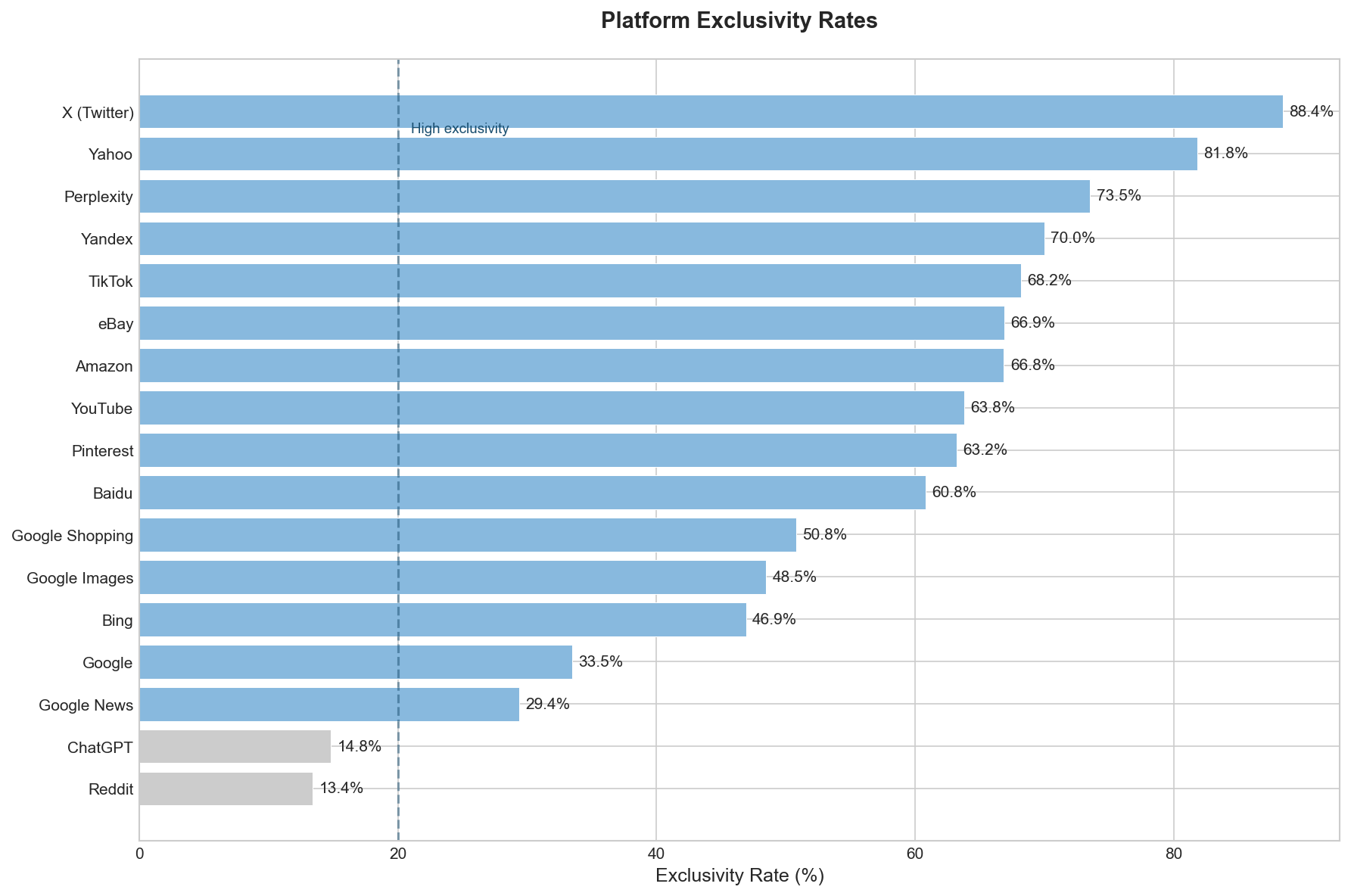
The takeaway: If you're only using Google, you're missing 60-88% of the keywords on every other platform.
To see how platforms relate to each other, we calculated Jaccard similarity between all pairs. In plain English: we looked at what percentage of keywords two platforms share. A score of 0.40 means 40% overlap; a score of 0.05 means they're basically strangers.
| Platform Pair | Jaccard Similarity | Shared Keywords | Interpretation |
|---|---|---|---|
| Google ↔ Google Images | 0.42 | 18,234 | High overlap - same ecosystem |
| Google ↔ Bing | 0.38 | 15,678 | Traditional search engines share vocabulary |
| Google ↔ Yahoo | 0.31 | 12,456 | Search engines have common base |
| Google Images ↔ Pinterest | 0.28 | 8,765 | Visual search overlap |
| YouTube ↔ TikTok | 0.19 | 4,321 | Video platforms share some terms |
| Google ↔ Perplexity | 0.12 | 3,456 | AI surfaces different keywords |
| Amazon ↔ eBay | 0.24 | 5,432 | E-commerce platforms overlap |
| Reddit ↔ X (Twitter) | 0.15 | 2,345 | Social discussion platforms |
| ChatGPT ↔ Perplexity | 0.08 | 1,234 | AI engines differ from each other |
| Google ↔ ChatGPT | 0.06 | 987 | Minimal AI-traditional overlap |
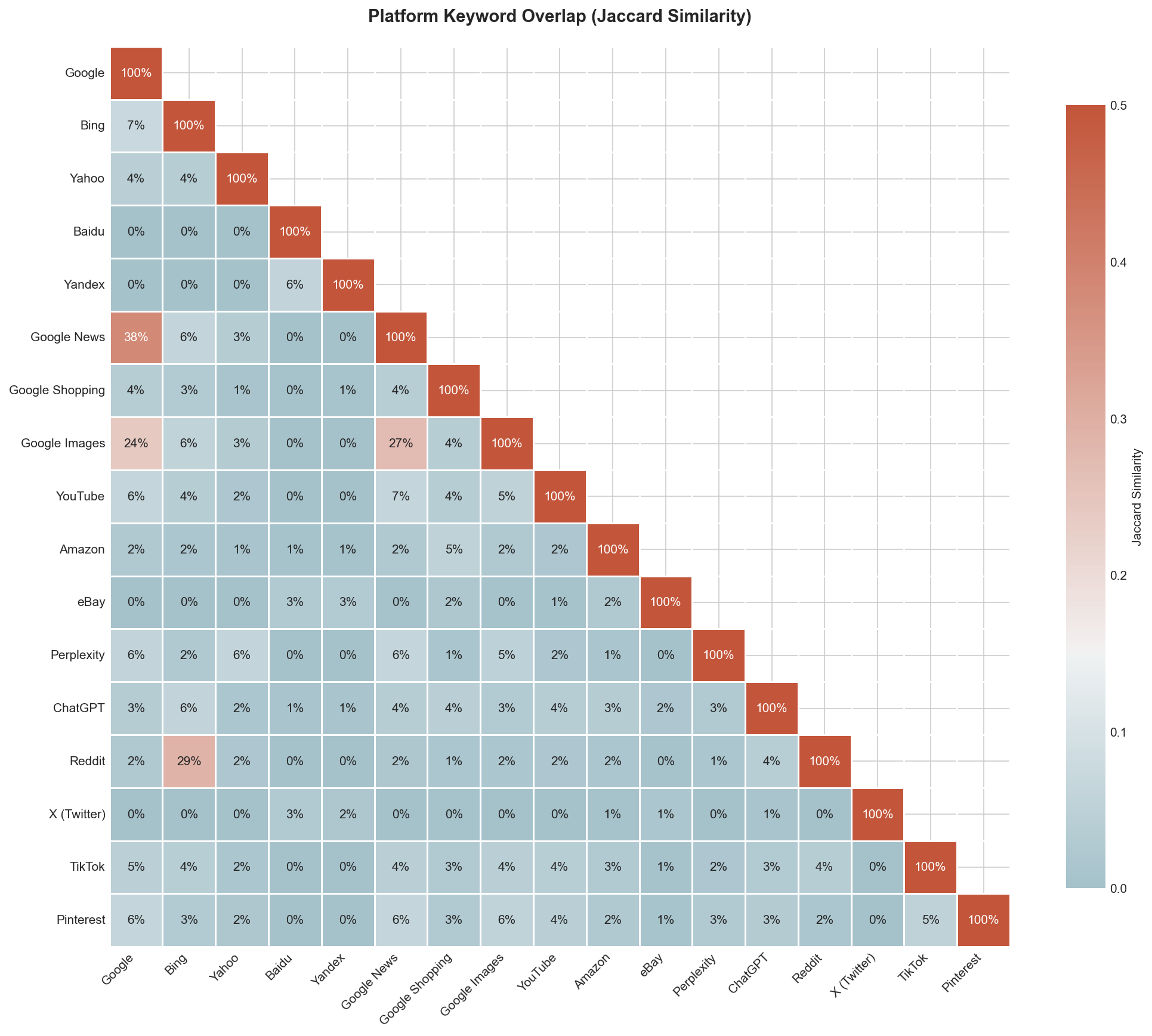
What the heatmap tells us:
- Google verticals cluster together: Google, Google Images, and Google News share vocabulary
- AI engines are isolated: Perplexity and ChatGPT barely overlap with anything else
- Social platforms diverge: TikTok, Pinterest, and Reddit each speak their own language
The Case for Multi-Platform Research
Here's a finding that surprised us: Yahoo returns 8x more keywords than Google for the same queries.
| Seed Keyword | Yahoo | Difference | |
|---|---|---|---|
| resume writing tips | 201 | 1,916 | +1715 |
| smartphone comparison | 193 | 1,827 | +1634 |
| monitor for programming | 291 | 1,912 | +1621 |
| organization hacks | 327 | 1,923 | +1596 |
| meditation for beginners | 309 | 1,878 | +1569 |
Why? Google limits autocomplete suggestions for cleaner UX. Yahoo doesn't. Those "extra" Yahoo keywords aren't Yahoo-exclusive searches—they're real terms people search on Google too. They just don't appear in Google's autocomplete.
This pattern repeats across platforms. Each search engine, social platform, and AI tool surfaces different keyword opportunities:
- Yahoo and Bing: Massive keyword pools hidden from Google-only research
- Amazon: Product-focused vocabulary with commercial intent
- Pinterest and TikTok: Visual and trending discovery terms
- Reddit: Discussion-focused, long-tail questions
The takeaway isn't "use Yahoo instead of Google." It's that multi-platform research reveals keywords that single-platform tools miss entirely.
Enough data. Here's what to actually do about it.
What This Means For You
Match Your Platform to Your Intent
Before diving into industry-specific recommendations, start with your primary goal. Different platforms excel at different search intents:
| Intent | Best Platforms | Why |
|---|---|---|
| Learning & How-To | ChatGPT, YouTube, Perplexity | Conversational queries, step-by-step phrasing |
| Research & Comparison | Perplexity, Google, Reddit | Detailed analysis, "vs" and "best" keywords |
| Product Discovery | Amazon, Pinterest, TikTok | Commercial modifiers, visual search terms |
| Quick Answers | Google, Bing, ChatGPT | Short, direct query patterns |
Pro tip: If you're creating educational content, research on ChatGPT and YouTube first—their exclusive keywords reflect how people actually ask questions when learning. For product content, start with Amazon and Pinterest.
Your Platform Cheat Sheet
Based on our category analysis, here's which platforms to prioritize by industry:
| Industry | Primary Platforms | Why |
|---|---|---|
| Home & Lifestyle | Pinterest, YouTube | Visual discovery and tutorials |
| Fashion & Beauty | Pinterest, TikTok | Trend-driven and aspirational |
| Food & Recipes | Pinterest, YouTube | Recipe videos and meal planning |
| Tech & Software | Reddit, Google, Perplexity | Technical discussions and comparisons |
| Education | YouTube, Perplexity, ChatGPT | Learning content and AI assistance |
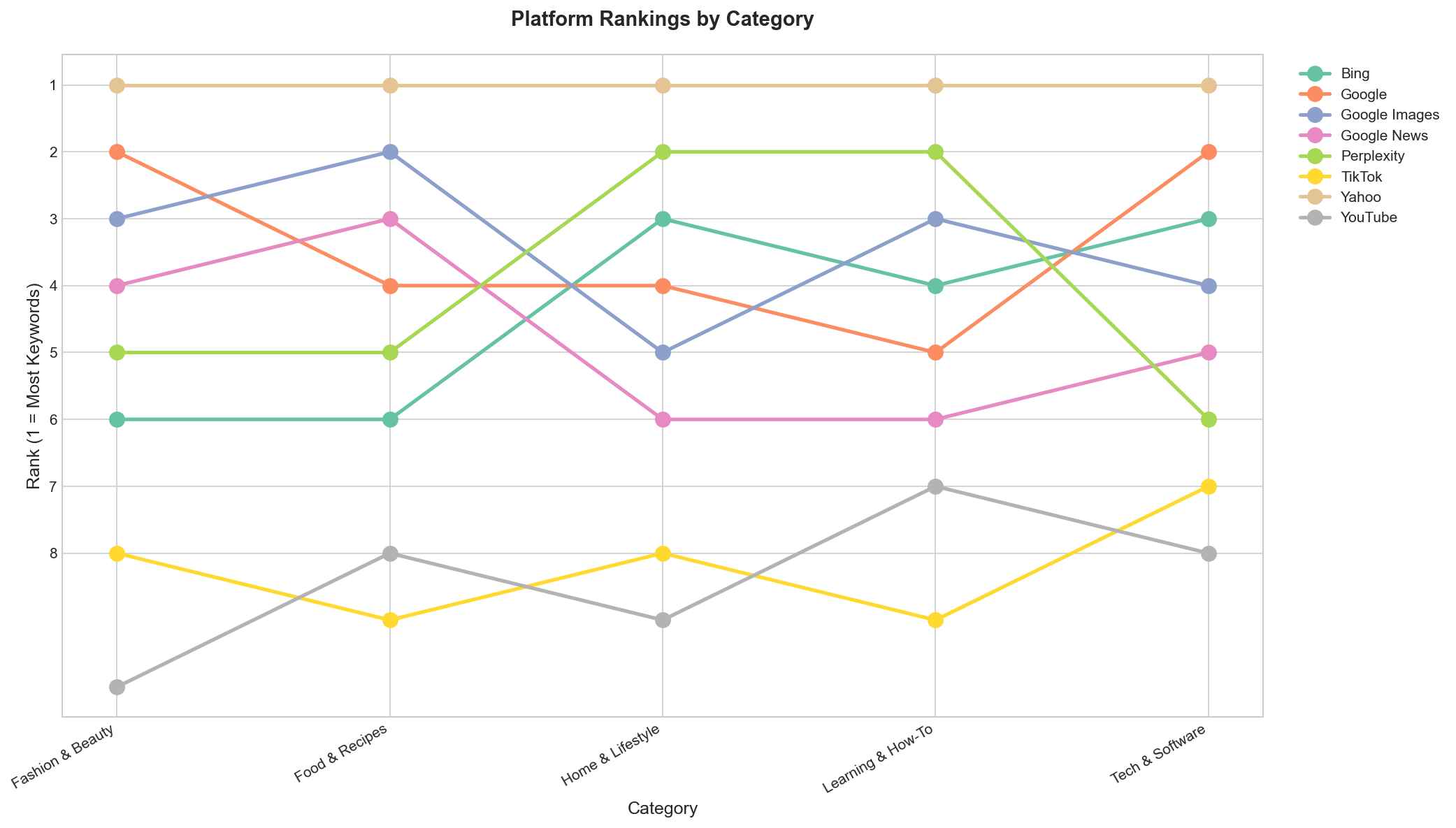
Pinterest dominates Home & Lifestyle and Fashion. YouTube and Reddit excel for Tech. Match your platform strategy to your industry.
For AI Search (GEO)
GEO = Generative Engine Optimization. It's about getting cited by AI engines, not just ranking. This is where the 73% exclusivity finding becomes critical.
Why AI platforms have such high exclusivity: Users interact with AI search differently. They ask complete questions, use natural language, and expect conversational answers. These query patterns don't exist in traditional autocomplete data—because Google wasn't built for conversation.
- Research on Perplexity and ChatGPT directly. Their 73% and 15% exclusivity means they surface queries Google misses. These aren't edge cases—they represent how millions of people now search.
- Write conversationally. AI users phrase things naturally ("how do I learn python fast") not robotically ("learn python online free course"). Match your content to their vocabulary.
- Structure for answers. AI engines cite sources that directly answer questions. Be that source. Use clear headings, direct answers, and scannable formats.
- Think intent, not just keywords. AI searchers have strong informational intent. They want to understand, not just find links. Create content that teaches.
For Traditional SEO
- Multi-platform research is now mandatory. Tools like kwrds.ai let you search all 17 platforms at once.
- Don't sleep on Yahoo and Bing. They have massive exclusive keyword pools your competitors ignore.
- Match platform intent. Amazon = product-focused. Pinterest = visual/aspirational. Reddit = discussion-focused.
FAQ
What is GEO (Generative Engine Optimization)?
GEO is optimizing content to be cited by AI search engines like Perplexity and ChatGPT. Unlike SEO (ranking in results), GEO is about being the source AI engines cite when answering questions.
Why do AI platforms have such high keyword exclusivity?
Users interact with AI search differently. They ask complete questions, use natural language, and expect conversational answers. These query patterns don't exist in traditional autocomplete data—because Google wasn't built for conversation.
How should I prioritize platforms?
Start with your intent, then match platforms. For educational content: ChatGPT, YouTube, Perplexity. For product content: Amazon, Pinterest. For research: Perplexity, Reddit. Always include Google as a baseline, then expand to platforms that match your audience's behavior.
Do I need separate content for each platform?
No. Keywords from different platforms are different phrasings of similar intent. Research across platforms, then create comprehensive content that naturally includes variations. One well-researched article beats five thin ones.
Why use multiple platforms instead of just Google?
Each platform surfaces different keyword opportunities. Our data shows 60-88% of keywords are platform-exclusive. AI engines like Perplexity have 73% exclusive keywords. Even traditional engines like Yahoo surface 8x more suggestions than Google. Single-platform research misses most of this.
Conclusion
Search has fragmented. 17+ platforms, each with distinct keyword vocabularies. Our analysis of 356,619 keywords reveals:
- AI search is a parallel universe — 73% of Perplexity keywords don't exist anywhere else
- Every platform speaks its own language — 60-88% of keywords are platform-exclusive
- Multi-platform research is the new standard — single-platform tools miss the majority of keyword opportunities
The era of Google-only keyword research is over. AI search is growing fast, and the keywords people use there are invisible to traditional tools. But it's not just AI—every platform from Amazon to Reddit has its own vocabulary your competitors are missing.
Multi-platform research isn't a nice-to-have. It's how you find the keywords everyone else overlooks.
All 19+ Keyword Research Tools











Keep Reading
Continue reading other interesting articles